
Best 12V Fans for RV: Keep Cool Without Blowing a Fuse
If you’ve ever tried sleeping in an RV on a summer night without a fan, you know what it’s like to roast in a rolling oven. A good 12V fan can turn a sauna on wheels into a bearable, even breezy, little refuge.
These fans are compact, portable, and run off your RV’s battery. That makes them a go-to for off-grid cooling or just moving air around when you’d rather not fire up the air conditioner.
RV fans aren’t all the same. Some barely whisper, while others sound like you’ve fired up a jet engine next to your pillow.
When it comes to picking the right fan, a few things matter: noise level (unless you love white noise), how much airflow you actually get, and how much power it draws from your battery. Features like pivoting heads, mounting options, and adjustable speeds can make a surprising difference in comfort—or just help avoid mutiny from sweaty travel companions.
We spent hours researching and testing a batch of top 12V fans to find the ones that actually keep us cool in our RVs. Sometimes that meant sorting out fan-shaped imposters or braving the occasional hair disaster.
Best 12V Fans for RV
Life in an RV can get stuffy fast—unless there’s a fan working overtime. Our list of the best 12V fans for RVs should help keep the air moving and stop us from sweating through another game of cards.
Let’s find the perfect fan before our shirts become a towel alternative!
Facon Heavy Duty 12V RV Fan
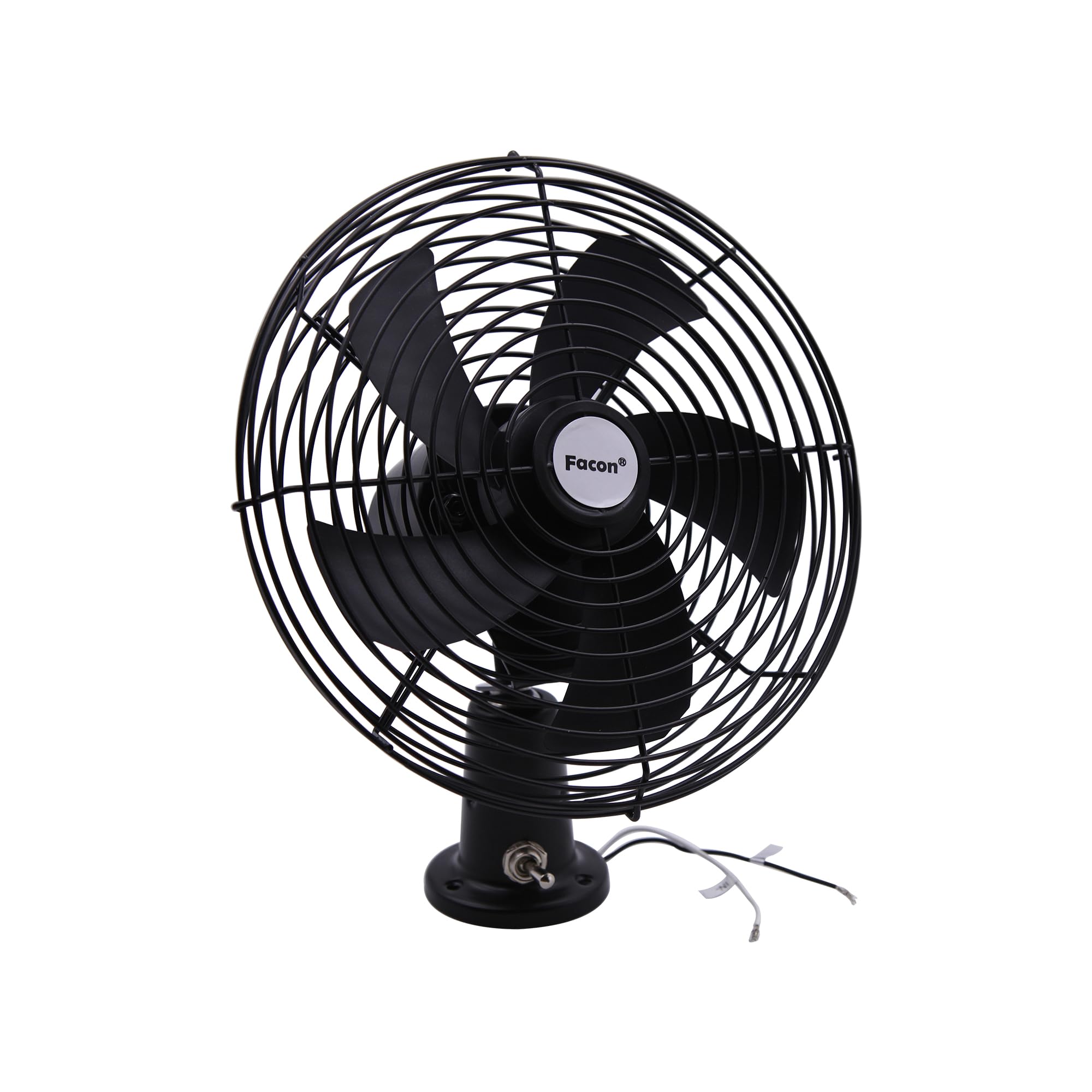
Tired of sweating through your shirts in the RV? This fan is a solid pick if you want simple cooling without a lot of fuss.
Pros
- Built sturdy with a mix of metal and strong plastic, so it feels like it’ll outlast our last three camp chairs.
- Two speed settings—one for a gentle breeze, the other for pretending you’re in a wind tunnel.
- Easy permanent mounting, so it doesn’t fall on your head during bumpy rides.
Cons
- Can be a bit noisy on high, not ideal if you’re a fan (get it?) of total silence.
- Not cordless; you’ll have wires to deal with, which isn’t always fun in tight RV spaces.
- Some might want more than two speeds, especially when nobody can agree on a breeze level.
After bolting this Facon fan onto the RV wall, we noticed pretty quickly it moves air well—almost enough to unstick that one family member from the vinyl couch.
The two speed options let us go from quiet background airflow to “let’s clear the air in here fast.” That came in handy after taco night.
Getting it installed didn’t require an engineering degree, but we did have to get creative with the wiring since it has a fixed mount design.
What stands out is the hefty construction. The base is solid and didn’t wobble when we bumped it with our elbows in the narrow galley.
The plastic blades felt more durable than your average budget fan, and after a week of constant use, there were no mystery noises or wobbles.
The three-way switch is simple, but it does the trick and doesn’t require us to be electrical wizards.
It’s not flawless. On high speed, it’s a bit louder than we’d like, and honestly, RV life is noisy enough—between this and the dog snoring, sleep might require earplugs.
The wires are short, so if you’re mounting it far from your power source, you’ll need some extra wire.
But for those hot, stuffy afternoons, it’s worth the minor hassles just to keep some air moving and our tempers cool.
RoadPro Heavy Duty 12V Metal Fan

If you want to feel a refreshing breeze while battling summer heat in your RV, this fan is more powerful than our grandmother’s opinions—just be ready for a bit of noise.
Pros
- Moves a lot of air quickly—perfect for stuffy spaces.
- Durable all-metal build stands up to bumps and road trips.
- Super long power cord means you don’t have to rearrange the whole RV.
Cons
- It’s noisy enough that napping near it takes serious earplugs.
- Some vibration after a while makes it sound like a spaceship.
- The switch on ours fumbled between speeds sometimes.
We tried out the RoadPro fan on the hottest day of the week and felt instant relief—seriously, it made the inside of the RV go from “swampy” to “bearable” in seconds.
The all-metal construction feels solid, so if you accidentally bump it or it takes a tumble, it keeps going.
Mounting was a breeze (pun intended), and that ten-foot cord let us reach basically anywhere we wanted.
Let’s talk about noise, though. On high, this fan is loud—like, “are we idling next to a jet?” loud.
It pumped out lots of air, but we definitely had to turn up our conversation volume. Forget about sleeping with it running unless you want a free white noise machine.
We noticed a bit of vibration after using it for a while, especially if we tried to change the speed, but it never quit on us.
For airflow, it really does the job, and we love not having to wrestle with short cords or useless mounting hardware.
If you’re after something to cool you off, the RoadPro Heavy Duty 12V Metal Fan is a solid pick—as long as you don’t mind pretending you’re at a wind tunnel test facility.
TriPole Dual Head RV Car Fan

If you want your RV air to move faster than your dog’s tail when you open a bag of treats, the TriPole Dual Head Fan is a clever pick for quick cooling.
Pros
- Both driver and shotgun passenger can enjoy separate breezes.
- Compact size saves dashboard space.
- Sticks well with handy 3M tape.
Cons
- Makes a bit of humming noise—subtle, but it’s there.
- Uses two motors, so don’t expect it to sip electricity.
- Not cordless; the power cord turns us into a “plug-here, stretch-there” artist.
When the AC goes kaput and it’s just us and the summer sun, this fan might be the affordable hero we didn’t know we needed.
The dual heads give us the power to blast stinky air out fast, and with three wind speeds, we feel like captains of the breeze—assuming our co-pilot doesn’t try to commandeer both fans.
We can twist and aim both heads in almost any direction, giving our pets (and sweaty selves) some much-needed relief.
Sticking the base to the dashboard with the included 3M tape takes about 60 seconds, which is only slightly longer than it took us to regret letting the dog ride up front.
The fan manages to look more expensive than it actually is, thanks to a leather-feel finish that doesn’t scream “auto parts bin special.”
It’s not exactly silent—we notice a little hum, especially when cranking up the highest setting.
And since each little fan chugs its own wattage, using both at once does pull a bit more juice. Still, in the grand RV power game, it barely makes a dent unless you’re running a concert’s worth of electronics anyway.
For something to keep the air moving (and the dashboard uncluttered), it ticks most of the boxes—minus the box for “wireless freedom.”
Kohree 14″ RV Roof Fan

If you want a cool RV without waking the neighbors or your own grumpy self, the Kohree 14″ RV Roof Fan has a lot to offer.
Pros
- Keeps air moving fast and efficiently.
- Simple install with handy extras included.
- Runs quietly even when cranked up.
Cons
- Remote control could be easier to figure out.
- Lid vibrates a bit on windy days.
- Mounting screws aren’t self-tapping.
This Kohree fan impressed us right out of the box—no wild science project skills needed for the install.
All the pieces were included, from extra sealing tape (thank you!) to the mosquito-proof screen. The hardest part was wrestling off the old caulking.
Once in place, it fit our roof’s 14-inch cutout perfectly.
On sweaty afternoons, the airflow was a game changer.
We noticed the temperature sensor kicking in automatically just as we started to bake—fans of self-preservation will appreciate that.
The powered lid pops open and closes on its own. It even got nervous about the rain before we did, shutting itself in before our snacks got soggy.
The remote control is a bit of a brain teaser, so we ended up poking buttons just to see what would happen.
Once we figured it out, the ten adjustable speeds became a crowd favorite, and the noise never got loud enough to scare away our afternoon nap.
The only mild let-down was the lid shivering on windy nights, but we survived thanks to our survival skills and earplugs.
Honestly, we’d pick this fan again if our RV had more roofs.
Beech Lane 12V RV Fridge Vent Fan

If our RV refrigerator had a secret superhero, it would probably be this fan.
Pros
- Powerful airflow that actually makes the fridge colder.
- Super easy install on American RVs (no zip ties needed, finally).
- Remote with auto temperature mode is convenient and fun to use.
Cons
- Fan isn’t exactly a whisper, especially at full speed.
- Needs a bit of space behind the vent (they’re chunky).
- Remote feels a bit unnecessary if you’re not a gadget person.
We’ve tried our share of sad, overheating RV fridges. As soon as we put in the Beech Lane fan, things changed—suddenly the fridge kept cool snacks, even during those Florida summer meltdowns.
Those big fans kicked hot air out so much faster than anything smaller we’ve seen. We didn’t have to pretend the lettuce was supposed to be wilted.
The mounting was a pleasant surprise too. Most fans seem to think we live in Europe and love zip ties, but this one fits right onto our American RV vent with sturdy brackets.
No wrestling, no cursing—just a straight swap and it’s done.
Switching from manual to auto with the quirky little remote made us feel high-tech. We set our preferred temp and left the rest to the fan.
Sometimes, though, the fan isn’t exactly sneaky. On high, you’ll hear it if you’re outside.
It also needs a little room behind the vent, so double-check your space before getting your hopes up.
But all things considered, with this fan running, we no longer have to plan meals around a lukewarm fridge. Victory!*
Homdec 12V RV Cooling Fan

If you need a sturdy fan that’s easy to install and don’t mind a bit of noise, this is a strong option for your RV adventures.
Pros
- Built with tough metal, so it doesn’t feel cheap
- Simple installation—we barely needed tools
- Two speed settings are handy for changing weather
Cons
- Makes enough noise to drown out our terrible singing
- Airflow could be stronger, especially on hot days
- Blades are plastic, not metal as we’d hoped
When we wanted to banish stale air in our RV, we gave this Homdec fan a try. Its burly metal frame felt right at home bolted to our ceiling.
The two-speed toggle is basic but makes sense—there’s nothing here to confuse our groggy selves in the middle of a muggy night. We had it installed in fifteen minutes, and only misplaced one screwdriver in the process.
The airflow keeps things comfortable, especially on days when we marathon snacks and card games. If the RV turns into a rolling oven, though, this fan isn’t going to blast arctic breezes.
On the plus side, it’s great at kicking out pet smells and humidity, so we don’t end up driving around in a mobile greenhouse. Now, about the sound level—if you’re into the soothing sound of a jet engine at takeoff, this model’s got you covered!
Okay, that’s an exaggeration—but it’s definitely not whisper quiet. We found ourselves raising our voices, or just giving up and using charades when the fan was on high.
SEEKR Sirocco II RV Fan

If your RV needs an ultra-quiet, all-angle, super-adjustable fan (and you don’t mind some awkward installation), this SEEKR is a smart pick.
Pros
- Turns 360° to hit every sweaty corner
- Runs so quietly we have to check if it’s still on
- Built-in timer so we can pretend we’re tech-savvy
Cons
- Costs more than our last trip’s grocery bill
- Installation is a code-breaking puzzle
- Not the most powerful breeze on the highest setting
Let’s be honest, RVs get hot enough to bake cookies on the dash. The SEEKR Sirocco II stepped up big time with its gimbaled, spinning-everywhere design—finally, we can point the breeze exactly where we want it.
It runs quietly, barely louder than a whisper, so we can actually hear each other argue about directions. The fan offers three speeds and has an awesome auto-off timer—no more waking up at 3AM to turn things off or getting roasted in the morning.
We especially appreciated how energy-efficient it is, gently sipping power from our rig’s battery. On the hilarious side, installing it was as fiddly as assembling a Swedish bookshelf with your eyes closed.
The included wiring felt about as durable as spaghetti, so we switched it out for better stuff. We love the flexibility and how flat it folds away, but for the money, we kind of wish it could brew coffee too.
QIFUN Dual Head 12V Clip Fan

If you’ve ever felt like a melted crayon in your RV, you’ll want this fan by your side.
Pros
- Dual fan heads let us aim wind at whoever’s whining the most
- Clamp stays rock solid, even on bumpy roads (or when the dog gets rowdy)
- Stepless speed dial is fun to play with—and it really cools the place fast
Cons
- Power cord looks like we’re fishing for radio waves
- Not exactly a piece of modern art
- Gets nudged out of place every time someone bumps it
Using this QIFUN clip fan in our RV felt like a victory over desert sun. We’re big fans (pun intended) of the dual heads, because not everyone chills at the same temperature.
Spinning the fan heads around is as satisfying as steering a spaceship, and we all fight over who gets air first. Mounting the clamp requires zero tools and less patience than our last attempt at assembling lawn chairs.
Once it’s on, it doesn’t budge—unless our dog uses it as a scratching post. The cable’s so long, we joked about using it as a jump rope.
Stretching it to the back seats is a breeze, and we’ve kept everyone—from the driver to the “are-we-there-yet” crowd—pretty comfortable. The only real downside? Our RV’s not going to win any design awards with it installed.
But when we’re cool and sweat-free, we don’t care. With a twist of the dial, the airflow goes from gentle to “let’s recreate a wind tunnel.”
This thing may not make up for a broken A/C, but it absolutely makes summer trips humanly possible.
Weideer 6″ RV Vent Fan & Motor Kit

If you want a no-nonsense fix for a dead vent fan that won’t leave you sweating in your own RV bathroom, this kit is a solid bet.
Pros
- Installation made us look like RV repair pros
- Impressively pushes out steamy shower air
- Runs quieter than our last RV fan
Cons
- Sometimes needs drilling if your old mount holes don’t fit
- Motor is bulkier than some OEM fans
- Blade isn’t the perfect fit for all vent covers
We got our hands on the Weideer 6″ RV vent fan when our old one finally gave up from too much exposure to questionable camp cooking. Setting it up was easier than convincing everyone else in the RV to do the dishes.
Just match the wire colors and screw things in place. The kit comes with all the screws and zip ties we needed.
The included switch actually feels sturdy, so we aren’t worried it’ll snap after a few too many bathroom trips. Airflow is the real winner here.
After a sweaty summer weekend, we fired up the Weideer and watched musty bathroom air whisk away in minutes. Showers are less like saunas now.
Another benefit—we barely notice it’s running, except when it’s finally quiet again and we realize someone didn’t burn the eggs for a change. The motor’s a bit chunkier than the old one, so we had to break out the drill to widen some holes in our vent cover.
The fan blade fits well for us, but if your vent cover is a mysterious size, you might need to get inventive. For a basic replacement that gets the job done, the Weideer kit saves us a trip to the parts store and a whole lot of sweat.
RUSFOL 6” RV Vent Fan & D-Shaft Motor

If you want your RV to smell less like last night’s dinner and more like, well, not last night’s dinner, this fan might be just what you need.
Pros
- Does a surprisingly good job getting rid of stubborn bathroom smells
- Plastic blade laughs in the face of rust and corrosion
- We can pick which way the fan spins—clockwise or counterclockwise
Cons
- Can get noisy, so it might not be “library quiet”
- Wires could be longer, unless we like creative rerouting
- Motor gets pretty warm after a few minutes
Popping in the RUSFOL fan was less stressful than parallel parking our rig. We swapped out our old, tired fan and noticed right away how much better this one pulled air—even our sneaky kitchen odors didn’t stand a chance.
That reverse polarity trick is a lifesaver if we ever wire things up backwards (not that we ever make mistakes, right?). The plastic fan blade feels solid—no more worrying about it falling apart after a few sweaty summer trips.
Rust and corrosion? Not today! We did notice the wires weren’t exactly long enough for the lazy installer in all of us, so we had to get a little creative with connections.
Adding a couple of wire extensions made the whole process a lot simpler. This fan is not winning any stealth awards for quiet operation, but it’s no jet engine either.
After running it non-stop for a bit during a muggy afternoon, the motor got pretty warm to the touch. For this price, we’re not complaining—and at least we know it’s working hard to keep our RV air fresh and not funky.
If you’re ready to give your RV vent a glow-up, this fan is a no-fuss choice that actually works.
Buying Guide
When we start looking for a 12V fan for our RV, things can get confusing fast. There are more choices than socks in our laundry basket!
Luckily, we can make our shopping easier by focusing on the most important features. First, we want to check the size and airflow.
Not all fans fit in every space, and some blow air like a gentle breeze while others could almost double as a wind tunnel. Let’s match the fan size to our space and needs.
Noise matters. Some fans are so quiet we question if they’re on; others might sound like a helicopter is landing in our RV.
If we want to sleep or think inside, quieter is usually better. A good fan shouldn’t turn our battery into a paperweight.
Energy efficiency is key. Lower power draw helps us enjoy the cool air without running out of electricity.
Here’s a simple table to help us compare features:
| Feature | Why It Matters | What To Look For |
|---|---|---|
| Size | Fit and airflow | Measure our space |
| Noise level | Comfort and peace | Decibel rating, reviews |
| Power draw | Battery life | Lower amps/watts is better |
| Speed settings | More control | 2+ speed options |
| Mounting options | Versatility | Clip-on, wall, ceiling, stand |
Let’s not forget ease of installation. We don’t want to end up reading a 500-page manual or calling in an engineer.
A simple setup saves our time (and sanity). Lastly, we can look for extra perks like adjustable head, oscillation, or even a remote.
Because sometimes, we want to feel fancy here in our rolling home!
Frequently Asked Questions
We all want to keep our RVs cool, quiet, and comfortable. Nobody wants to blast their wallets or eardrums just to stay chill.
Let’s dig into fan features, noise levels, extra gadgets, and whether a “breezy” fan can really make a difference on a summer road trip.
How do you spot a breezy intruder? I mean, which 12V fan is the top wall-mounted whisperer for RVs?
Finding the right wall-mounted fan feels like a detective mission. The Caframo Sirocco II usually gets top marks for quiet operation and easy wall-mounting.
It doesn’t creak in the night or rattle during bumpy rides. We just look for models with easy swivel, multiple speeds, and a solid mounting bracket.
If a fan asks for power tools just to stay up, we’re out.
What’s a stealthy way to cool an RV? Are there any 12V fans that won’t sound like a hurricane?
Our ears deserve better than motorboat-level buzzing! The Sirocco II and Maxxair Turbo fans push air with a purr, not a roar.
They give us a cool breeze and let us nap or read without background noise that sounds like we’re standing on a runway. We’ve noticed that fans with brushless motors usually run the quietest.
Fans with adjustable speeds help dial down the decibels even more.
Is it true that some 12V fans come with a battery, or is that just a breezy myth?
Most 12V fans don’t pack their own battery, no matter how much we wish they’d just run on good vibes and hope. They’re made to connect straight to our RV’s electrical setup or a 12V outlet.
There are some portable ones with built-in rechargeable batteries. Most heavy-duty RV fans stick to wired power.
If my RV’s a-rockin’, don’t come a-knockin’! But seriously, will ceiling fans keep my camper cool without taking it airborne?
Ceiling fans do help with air circulation, especially if our RV likes to double as a greenhouse in the sun. They’re lighter than regular house fans and install flat against the ceiling, so we’re not risking lift-off.
We just need to secure them well—otherwise, a rough road turns “ceiling fan” into “flying frisbee.” Safety first!
Do 12V fans for RVs pack enough punch, or are they just blowing hot air?
A good 12V fan can make a real difference on those sticky days. Brands like Heng’s or Maxxair move air well enough to stop us from melting into the sofa.
Just don’t expect blizzard levels of wind. If we want to reenact a wind tunnel, we’ll have to step outside during a storm.
Can a Sirocco 12V fan blow me away, or is it just a gentle zephyr in the world of RV fans?
The Sirocco II gets a lot of love from RV folks. With three speed settings and adjustable rotation, it pushes out enough air to keep us comfortable.
But let’s be honest, it’s not going to mess up your hair like a convertible on the highway. It’s great for sleeping or working.
You don’t have to worry about paperwork flying everywhere—or anyone losing a toupee.